

Picture this: you’re running a bank or insurance company, & your technology feels like trying to use a smartphone app that constantly needs updates, permissions, & workarounds. That’s exactly what many financial institutions experienced with Salesforce’s original managed package approach. But then something REVOLUTIONARY happened – Salesforce made a bold decision to transform Financial Services Cloud from a managed package into a core platform feature. This wasn’t just a simple upgrade; it was like moving from a rented apartment to owning your dream home.
The financial services industry has always been unique, with complex regulations, intricate customer relationships, & data requirements that would make other industries dizzy. Traditional CRM systems often felt like trying to fit a square peg into a round hole when financial companies attempted to use them. Salesforce recognized this challenge & initially created Financial Services Cloud as a managed package – think of it as a specialized toolkit that sits on top of their main platform.
However, as the financial world became more digital & customer expectations skyrocketed, Salesforce realized that their clients needed something MORE powerful, more integrated, & frankly, more reliable. This article will explore the fascinating journey of why Salesforce made this strategic pivot, what it means for financial institutions, & how this change is reshaping the entire industry’s approach to customer relationship management.
The Limitations of Managed Packages in Financial Services
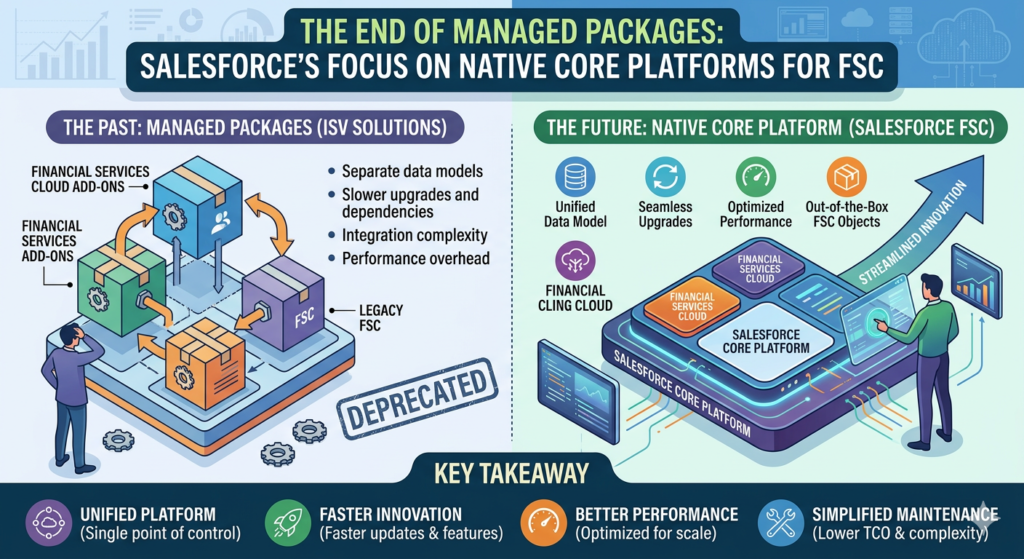
When Salesforce first introduced Financial Services Cloud as a managed package, it seemed like a smart solution. Think of a managed package like a pre-built app that you download onto your phone – it comes with specific features designed for a particular purpose. For financial services, this package included specialized tools for managing client relationships, tracking investments, & understanding complex family financial structures.
But here’s where things got TRICKY. Managed packages operate somewhat independently from the core Salesforce platform. It’s like having a really nice car accessory that doesn’t quite integrate perfectly with your vehicle’s main system. Financial institutions found themselves dealing with upgrade challenges, customization limitations, & integration headaches that made their IT teams pull their hair out.
Consider a large investment firm trying to customize their client portal. With the managed package approach, they often hit walls when trying to modify features to match their specific business processes. The package had predetermined ways of doing things, & stepping outside those boundaries meant complex workarounds or, worse, accepting limitations that didn’t serve their clients well.
The upgrade process was another nightmare. When Salesforce released updates to the managed package, companies had to carefully plan & execute these upgrades, often requiring extensive testing & potential downtime. For financial institutions where every minute of system unavailability can mean lost revenue & frustrated clients, this created significant operational stress.
The Strategic Shift to Core Platform Integration
Salesforce’s decision to move Financial Services Cloud into their core platform was like deciding to build a house with the foundation already perfectly integrated rather than trying to add rooms to an existing structure. This wasn’t just a technical change – it was a complete reimagining of how financial services technology should work.
When something becomes part of the CORE platform, it means it’s built into the very DNA of Salesforce. Instead of being an add-on that sits on top, Financial Services Cloud features became native components that work seamlessly with every other Salesforce feature. Imagine the difference between a phone case with a built-in battery (managed package) versus a phone with an extended battery built right into the device (core platform).
This integration meant that financial institutions could now access specialized banking & insurance features while simultaneously leveraging the full power of Salesforce’s ecosystem. Marketing automation, advanced analytics, artificial intelligence capabilities, & third-party integrations all became readily available without the complex bridging that managed packages often required.
The timing of this shift was crucial. As digital transformation accelerated across all industries, financial services found themselves needing to move faster, be more flexible, & deliver more personalized customer experiences. The managed package approach was becoming a bottleneck rather than an enabler, & Salesforce recognized that their clients needed a more robust solution.
Enhanced Performance & Scalability Benefits
Moving to the core platform delivered performance improvements that were immediately noticeable. Think about the difference between running an app on your phone versus using a feature that’s built into your phone’s operating system – the built-in feature typically runs smoother, faster, & more reliably.
Financial institutions deal with MASSIVE amounts of data. A single investment firm might manage thousands of clients, each with complex portfolios, multiple accounts, & intricate family relationships that need to be tracked & analyzed. When Financial Services Cloud operated as a managed package, this data had to travel through additional layers of processing, creating potential bottlenecks & slower response times.
With core platform integration, data flows more efficiently through the system. Customer information, transaction histories, & analytical insights can be processed & displayed faster, leading to better user experiences for both financial advisors & their clients. A wealth manager can now pull up comprehensive client information, run complex reports, & identify investment opportunities in seconds rather than minutes.
Scalability became another major advantage. As financial institutions grow, they need their technology to grow WITH them seamlessly. The core platform approach allows companies to expand their Salesforce usage across departments, add new users, & implement additional features without worrying about managed package limitations or compatibility issues.
Security enhancements also improved significantly. Financial services companies handle some of the most sensitive data imaginable – personal financial information, investment details, & confidential business data. Core platform integration means that all Financial Services Cloud features benefit from Salesforce’s enterprise-grade security infrastructure without requiring additional security layers or potential vulnerability points that managed packages might introduce.
Real-World Impact on Financial Institutions
The transformation from managed package to core platform has created tangible benefits that financial institutions can measure & appreciate. Let’s look at how different types of organizations have experienced these changes.
Large banks have reported significant improvements in their customer onboarding processes. Previously, setting up new accounts & integrating client information across different systems required multiple steps & often manual intervention. With core platform integration, these processes flow more smoothly, reducing the time it takes to get new customers fully set up & engaged.
Investment advisory firms have seen DRAMATIC improvements in their ability to provide personalized service. The enhanced integration allows advisors to access comprehensive client views that include investment histories, family relationships, financial goals, & communication preferences all in one place. This holistic view enables more meaningful conversations & better advice tailored to each client’s unique situation.
Insurance companies have benefited from improved claims processing & policy management capabilities. The core platform integration allows for better workflow automation, more efficient document management, & enhanced communication tracking throughout the policy lifecycle.
Credit unions, which often operate with smaller IT teams & budgets, have found the transition particularly beneficial. The reduced complexity of managing a core platform feature versus a managed package has freed up their technical resources to focus on other important projects while still providing their members with advanced CRM capabilities.
Future-Proofing Financial Services Technology
Salesforce’s move to integrate Financial Services Cloud into their core platform wasn’t just about solving current problems – it was about positioning their clients for future success. The financial services industry continues to evolve rapidly, with new regulations, changing customer expectations, & emerging technologies constantly reshaping the landscape.
By building Financial Services Cloud into their core platform, Salesforce has created a foundation that can adapt & grow with these changes. New features, artificial intelligence enhancements, & integration capabilities can be rolled out more seamlessly, ensuring that financial institutions stay competitive & compliant.
The integration also opens up exciting possibilities for innovation. Financial institutions can now more easily experiment with new technologies like chatbots for customer service, predictive analytics for investment recommendations, & automated compliance monitoring. These capabilities were technically possible with the managed package approach, but the integration complexity often made them impractical for many organizations.
REGULATORY compliance, which is crucial in financial services, has also become more manageable. Updates to compliance features can be deployed more quickly & consistently across all users, helping institutions stay current with changing regulations without major system overhauls.
Making the Most of This Evolution
The shift from managed package to core platform represents more than just a technical upgrade – it’s an opportunity for financial institutions to rethink how they use technology to serve their clients. Organizations that fully embrace this change are finding new ways to deliver value, improve efficiency, & create competitive advantages.
This evolution demonstrates Salesforce’s commitment to understanding & serving the unique needs of the financial services industry. By making Financial Services Cloud a core platform feature, they’ve shown that they’re willing to make significant investments in ensuring their solution truly meets the complex requirements of banks, investment firms, & insurance companies.
For financial institutions considering their CRM strategy, this change makes Salesforce Financial Services Cloud a more attractive & viable option. The reduced complexity, improved performance, & enhanced integration capabilities address many of the concerns that previously made organizations hesitant to adopt cloud-based CRM solutions.
The move also signals broader trends in enterprise software, where industry-specific solutions are becoming more deeply integrated with core platforms rather than existing as separate add-ons. This trend benefits users by providing more seamless experiences & reducing the technical overhead of managing multiple systems & integrations.
As we look toward the future, it’s clear that Salesforce’s strategic decision to integrate Financial Services Cloud into their core platform was both necessary & visionary, setting the stage for continued innovation & growth in financial services technology.
Additional Resources:
https://salesforceshastras.com/category/financial-services-cloud-fsc/
https://help.salesforce.com/s/articleView?id=000384864&type=1