Most financial services teams interact with Salesforce the same way they have for years. They log in, click through screens, update records, and run reports manually. It works, but it’s slow. And when you multiply that across loan processing, compliance checks, client onboarding, and case resolution, all those clicks add up to real drag on your operations.
Salesforce’s Headless 360 for Financial Services Cloud changes the equation. It strips away the browser entirely and turns the platform into a pure service layer. APIs, AI agents, and command-line tools replace the point-and-click interface. For financial institutions already under pressure to move faster, stay compliant, and do more with less, this is a significant shift in how work actually gets done.
This post breaks down what Headless 360 for Financial Services Cloud is, how its core components fit together, and why it matters specifically for Financial Services Cloud. You’ll see practical use cases like automated loan processing and real-time fraud detection, along with a clear look at what it takes to implement this in your organization.
Understanding Salesforce Headless 360: The API-First Revolution
What is Salesforce Headless 360?
Salesforce Headless 360 represents a fundamental shift in how financial services institutions can interact with their CRM platform. The browser is no longer required. Instead of logging into a user interface and clicking through screens, every Salesforce capability becomes accessible through direct programmatic channels.
Think of it this way: traditional Salesforce works like a physical bank branch where employees need to walk in, sit at terminals, and navigate through screens to serve customers.
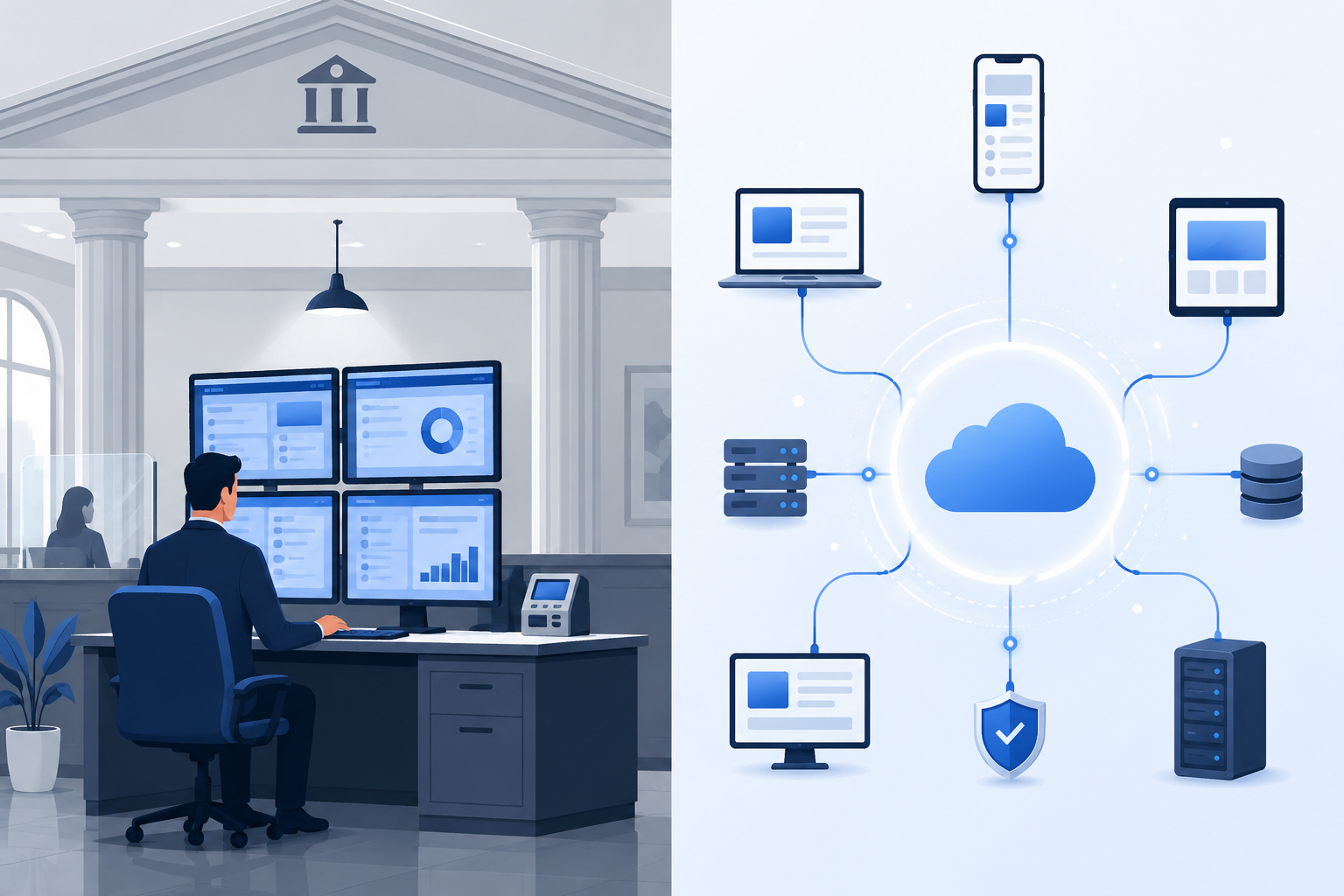 Salesforce Headless 360 works like a sophisticated API backend where apps, AI agents, and automation tools can access everything directly without the middleman of a visual interface.
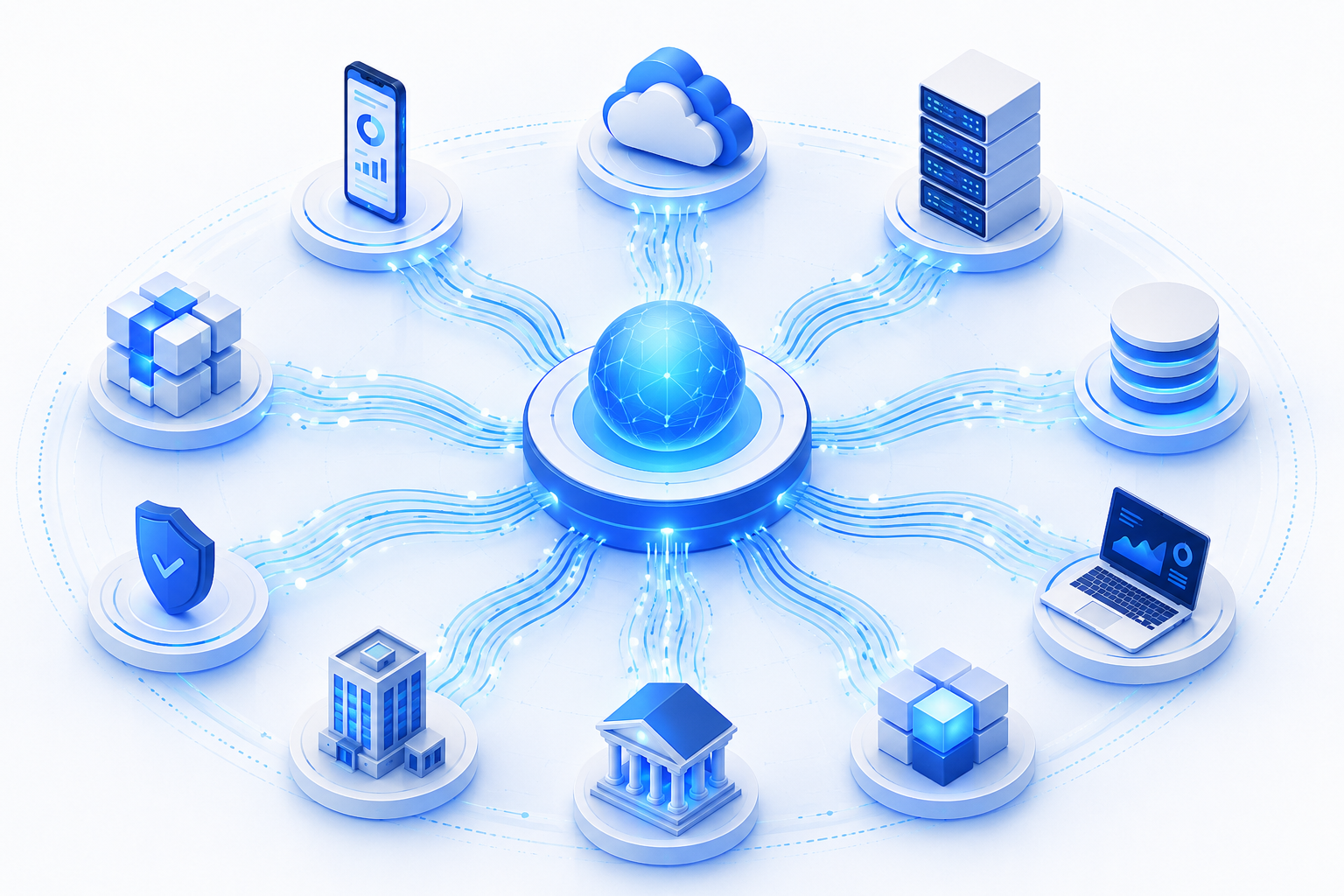
This architectural paradigm exposes the entire Salesforce platform as a service layer. APIs become the primary interaction method. MCP (Model Context Protocol) tools provide standardized access points. CLI commands let developers and automated systems trigger actions from terminals or pipelines. The result? Salesforce functions as a powerful engine that other systems can tap into seamlessly.
The scope is comprehensive. Everything from core CRM functions to Agentforce and Slack integrations gets exposed through these programmatic interfaces. Financial services organizations using Financial Services Cloud can now build custom experiences that pull Salesforce data and functionality without forcing users or agents to navigate the standard Salesforce UI.
Developers and businesses interact with Salesforce as a backend service rather than a platform with mandatory screens and forms. AI agents can retrieve customer data, update records, trigger workflows, and execute complex business logic without ever “seeing” a webpage.
Why the Shift to Headless Architecture?
Speed drives this transformation. Manual UI-based interactions create bottlenecks that slow down modern financial operations. When a loan officer needs to pull customer data, verify compliance status, and trigger approval workflows, clicking through multiple screens adds unnecessary friction and time.
Flexibility matters too. Financial institutions operate across multiple channels: mobile apps, voice systems, chatbots, partner platforms, and in-branch kiosks. A traditional UI-first approach forces each channel to either embed Salesforce screens (clunky) or build parallel systems (expensive and inconsistent). Headless architecture lets each channel access the same trusted data and functions through APIs while maintaining its native experience.
The business case for Financial Services Cloud implementations becomes stronger with headless capabilities. Scalability improves dramatically because automated processes can handle growing transaction volumes without proportional increases in human effort. A single API call can process hundreds of customer updates in the time it takes a person to load one record on screen.
The rise of the “Agentic Enterprise” accelerates adoption. AI agents are taking on more autonomous work, from customer service to compliance checks to portfolio management. These agents don’t need colorful dashboards or navigation menus. They need fast, reliable access to data and functions they can call programmatically.
Real-time decision-making becomes possible when systems can query Salesforce, analyze data, and execute actions in milliseconds rather than waiting for human operators to log in and navigate interfaces. Integration across platforms happens seamlessly because headless architecture eliminates the friction of screen-scraping or forcing external systems to mimic human browsing behavior.
Key Components and How Headless Salesforce Works
The API-First Platform forms the foundation. Every Salesforce function that previously required clicking buttons or filling forms now has a corresponding API endpoint. External applications, automated systems, and custom experiences can call these endpoints directly to read data, create records, update fields, or trigger processes.
Backend Automation runs workflows without human intervention. Approval processes, notification systems, data synchronization, and record updates execute programmatically based on triggers and rules. No one needs to log in and click “approve” or manually copy data between systems.
Browserless Integration connects Salesforce with systems like Slack, mobile applications, or internal tools without requiring anyone to open the Salesforce UI. A wealth manager’s mobile app can pull client portfolio data directly from FSC. A Slack bot can update opportunity records when team members message it with status changes.
Data 360 exposes trusted business data as queryable resources. Customer records, transaction histories, compliance statuses, and relationship maps become available as API responses, MCP tools, or CLI commands that AI agents can access by name. This creates a single source of truth that all systems and agents can reference.
Agentforce serves as the agent management layer. Financial institutions can build, deploy, and manage AI agents at scale through this component. It defines agent behaviors, sets guardrails, manages permissions, and orchestrates workflows. Agents built here can operate independently, calling Salesforce functions as needed without human oversight.
MCP Tools (Model Context Protocol) provide a standardized protocol that lets AI agents discover and use platform capabilities. Over 60 new tools and 30+ coding skills become available through this protocol. An AI agent can literally call a tool by name like “get_customer_credit_score” or “create_compliance_case” without needing to understand the underlying API structure.
CLI Commands give developers and AI agents the ability to trigger Salesforce actions directly from terminals or automated pipelines. DevOps workflows can include Salesforce operations alongside code deployments and infrastructure changes. Testing automation can set up data, run scenarios, and clean up environments through command-line scripts.
The Agentforce Experience Layer separates what an agent does from how it appears to users.
 This UI service lets rich interactive components render natively across different channels. The same agent logic can present a voice interface for phone calls, a chat interface for WhatsApp, a card-based interface for mobile apps, and structured messages for Slack. The agent’s capabilities remain consistent while the presentation adapts to each channel’s strengths.
Headless 360 in Financial Services: Benefits, Use Cases, and Implementation
Transformative Benefits for Financial Institutions
Financial institutions adopting Headless 360 discover immediate operational advantages. Speed becomes the first noticeable improvement. Processes that once required multiple screen loads and manual clicks now execute instantly through API calls. There’s no waiting for pages to render or forms to submit. The system simply acts.
This speed translates directly into efficiency gains across the organization. Manual effort drops dramatically. Human errors, those inevitable mistakes that happen when someone clicks the wrong button or enters data into the wrong field, virtually disappear. The APIs don’t make those mistakes.
Scalability changes the growth equation entirely. Traditional Salesforce implementations require more people as data volumes and workflow complexity increase. Headless architecture breaks this pattern. Your systems handle ten times the volume without hiring ten times the staff. The automation scales independently of headcount.
Flexibility opens doors that were previously locked. Financial services organizations often struggle with rigid systems that don’t play well together. Headless 360 for financial services cloud removes these barriers completely. Need to connect Salesforce with your legacy core banking system? Build the API integration. Want customer data flowing into your mobile app in real time? Route it through the data layer. The platform becomes genuinely agnostic about where and how it connects.
Innovation accelerates when AI agents can actually do things instead of just suggesting them. Real-time decision-making becomes standard operating procedure rather than an aspirational goal. Agent-based operations handle the routine work that buries your best people under repetitive tasks.
That reduced workload creates space for what actually matters. Wealth advisors spend time advising instead of updating records. Loan officers focus on complex cases rather than data entry. Compliance teams analyze risks instead of copying information between systems.
Customer experience improves across every touchpoint. A client might start a conversation on your mobile app, continue it through Slack, and finish via phone call. The unified customer data follows them seamlessly. Each interaction stays personalized because every channel accesses the same complete picture. No more asking customers to repeat information they already provided.
Real-World Use Cases in Financial Services Cloud
Voice-based case resolution shows the power of headless architecture in action. Picture a client calling about their account status. The AI agent answers, instantly pulls their complete customer record, reviews current account balances, checks for any compliance holds or restrictions, and either resolves the inquiry on the spot or transfers the call to a specialist with full context already loaded. No hold music while someone “pulls up your account.” No repeating your account number three times.
Automated loan processing eliminates the traditional bottlenecks. AI agents retrieve applicant data from multiple sources, verify employment and income details against third-party databases, cross-check credit scores, trigger the appropriate approval workflows based on risk parameters, and send status notifications to applicants. The entire preliminary process runs without a single person logging into Salesforce.
Personalized financial advice becomes scalable through headless APIs. An AI agent accesses a customer’s complete portfolio, pulls current market data and trends, analyzes performance against stated goals, and delivers tailored recommendations through whatever channel the customer prefers. Chat, mobile app, email, even voice. The intelligence stays consistent because it’s pulling from the same FSC data layer regardless of interface.
Fraud detection works best when it operates continuously. Headless systems monitor every transaction as it happens, compare patterns against known fraud indicators, flag suspicious activities the instant they occur, and automatically trigger blocks or alerts without waiting for someone to notice. Speed matters enormously when preventing fraudulent transactions.
Omnichannel customer engagement finally lives up to its promise with headless architecture. A customer starts an application on your website, saves it and switches to mobile while commuting, asks questions via your chat platform, then completes everything at a branch kiosk. The workflow never breaks. The customer profile updates in real time across all systems. Each touchpoint knows exactly where the customer left off and what they need next.
Compliance and regulatory reporting transforms from nightmare to non-event. Automated systems continuously collect required data points, validate them against regulatory requirements, generate reports on schedule, and flag any discrepancies for review. Financial regulations demand precision, and manual processes introduce risk. Headless automation removes human variability from compliance workflows.
Key Considerations for Implementation in Financial Services
Starting with an org health assessment saves pain later. You need complete visibility into your current data model, how information flows between systems, how many API calls you’re already making, what automation already exists, and where technical debt lurks. Skipping this step means building on a shaky foundation.
Agentic use case definition requires honest evaluation of where AI agents add value. Look for high-frequency tasks that people currently handle manually. Identify rule-based processes that require someone to log in, click around, and update records. These become your first targets for automation.
Data 360 architecture design establishes how agents access information. Define what “unified customer context” means for your organization. Map out your identity resolution strategy so systems know that the mobile app user, the chat contact, and the account holder are the same person. Specify exactly what data each agent type can access and under what conditions.
API and MCP architecture design gets technical quickly. Map every data exchange between systems. Define which API endpoints handle which functions. Establish authentication methods that balance security with usability. Plan error handling so failures don’t cascade. Build an API versioning strategy before you need one.
Agent behavior design and testing determines whether your AI agents help or cause chaos. Set up session tracing so you can see exactly what agents do and why. Build custom scoring evaluations that match your business requirements, not generic benchmarks. Run extensive testing cycles before letting agents interact with real customers or sensitive data.
Governance and security cannot be afterthoughts in financial services. Implement Agent Fabric to maintain centralized control over all agents, tools, and language models. Every agent action needs oversight. Every data access requires authorization. Operational safety and regulatory compliance depend on robust governance from day one.
Staffing presents a real challenge because headless implementations need diverse expertise. You need Salesforce architects who understand the platform deeply, API engineers who can build reliable integrations, and AI developers who know how modern agent systems work. This skill combination is rare and valuable.
Phased rollout protects you from expensive mistakes. Start small with a single use case. Measure actual business impact against your baseline metrics. Learn what works and what doesn’t. Expand gradually based on evidence rather than enthusiasm. Each phase should prove value before the next begins.

Conclusion
Salesforce Headless 360 represents a fundamental shift in how financial institutions can leverage their CRM platform. No more clicking through screens. No more manual data entry. The entire power of Financial Services Cloud becomes accessible through APIs, command line tools, and AI agents that work autonomously.

Think about what this means for your organization. Your loan officers won’t need to log into Salesforce to check application status. Your compliance team won’t spend hours compiling regulatory reports. Your customer service agents can access complete client histories through whatever channel works best, whether that’s Slack, a mobile app, or even voice commands.
The benefits are clear. Speed increases dramatically when processes run automatically. Scalability becomes manageable because systems handle growing workloads without adding headcount. Your teams get to focus on the work that actually requires human judgment and creativity, while AI agents handle the repetitive stuff that used to eat up their days.
Financial services organizations adopting Headless 360 aren’t just upgrading their technology stack. They’re fundamentally changing how work gets done. The API-first approach enables real-time decision making, seamless integration across platforms, and the kind of personalized customer experiences that build lasting relationships.
But successful implementation requires careful planning.
 You need to assess your current org health honestly. Map out which processes will benefit most from automation. Design your Data 360 architecture to provide the unified customer context your AI agents will need. Build in proper governance and security from day one through Agent Fabric controls.
The learning curve is real. Your team will need expertise in Salesforce architecture, API engineering, and AI development. Start with a phased rollout. Pick high-impact use cases, measure results against clear baselines, and expand based on actual evidence of success.
Financial Services Cloud customers who embrace the headless architecture are positioning themselves for the agentic enterprise future. The question isn’t whether to adopt this approach. It’s when and how you’ll begin your transition. The traditional browser-based model served its purpose well, but the future belongs to organizations that can leverage AI agents, automated workflows, and API-driven integration to deliver superior customer experiences at scale.
Your competitors are already exploring these capabilities. The Headless 360 framework gives you the tools to stay ahead. Start planning your implementation today.
Learn more about Financial Services Cloud